

Durable Multi Tools for Wilderness Survival: 5 Tested Picks
Table of Contents
- What Separates Durable Multi Tools From Gadgets
- Quick Comparison: 5 Durable Multi Tools for Wilderness Survival
- The Best Survival Multitools in This Lineup, Reviewed
- Choosing a Backpacking Multi-Tool by Weight and Task
- Survival Knife vs Multi-Tool: What Each One Does Better
- Multi-Tool Maintenance and Field Care That Prevents Failures
- Conclusion: Match the Tool to the Trip
- Frequently Asked Questions
Last Updated: October 7, 2026
What Separates Durable Multi Tools From Gadgets
A multi-tool earns its place when it survives the trip that breaks cheaper gear. At Outdoor Wilderness Supply, we judge every tool on materials, locking mechanism, and whether you'd trust it with your hands when the weather turns.
The gap between a gadget and a real survival tool shows up in the details. Heat-treated steel holds an edge; soft mystery metal folds or chips.
The Specs That Decide Survival Value
Four specs separate field-worthy tools from drawer clutter:
- Steel grade: 440C and D2 steel hold edges and resist corrosion; a stated quenching hardness confirms deliberate heat treatment.
- Locking mechanism: A locking blade or lock-in-place shaft means the tool won't fold on your fingers mid-task.
- Weight and packed size: Under a pound carries easily; two pounds is fine if it replaces three others.
Quick Comparison: 5 Durable Multi Tools for Wilderness Survival
Here's how the five tools compare on the specs that matter in the field:
| Tool | Price | Tools Included | Weight / Size | Best For |
|---|---|---|---|---|
| Stealth Tact Shovel | $69.97 | 12-in-1 | Collapses to 12", extends to 32.5" | All-around survival and camp tasks |
| Folding Shovel Multi-tool | $25.00 | 7-in-1 | 2 lbs, folds to 5" x 10" x 2" | Budget base camp and car camping |
| Multifunctional Folding Shovel | $24.99 | 6-in-1 | 0.45 kg, folds to 16 cm | Lightweight backpacking |
| Flex Titan Modular Tool | $109.99 | 6 FLEX implements + D2 blade | 311.2 g, 104 x 45 x 25 mm closed | Precision repair and modular flexibility |
| MBT3 Foldable BBQ Multitool | $35.99 | 6-in-1 | Compact folding design | Camp cooking |
The Best Survival Multitools in This Lineup, Reviewed
Each pick below solves a different problem. Read the one that matches your terrain, pack weight, and how you spend time outside.

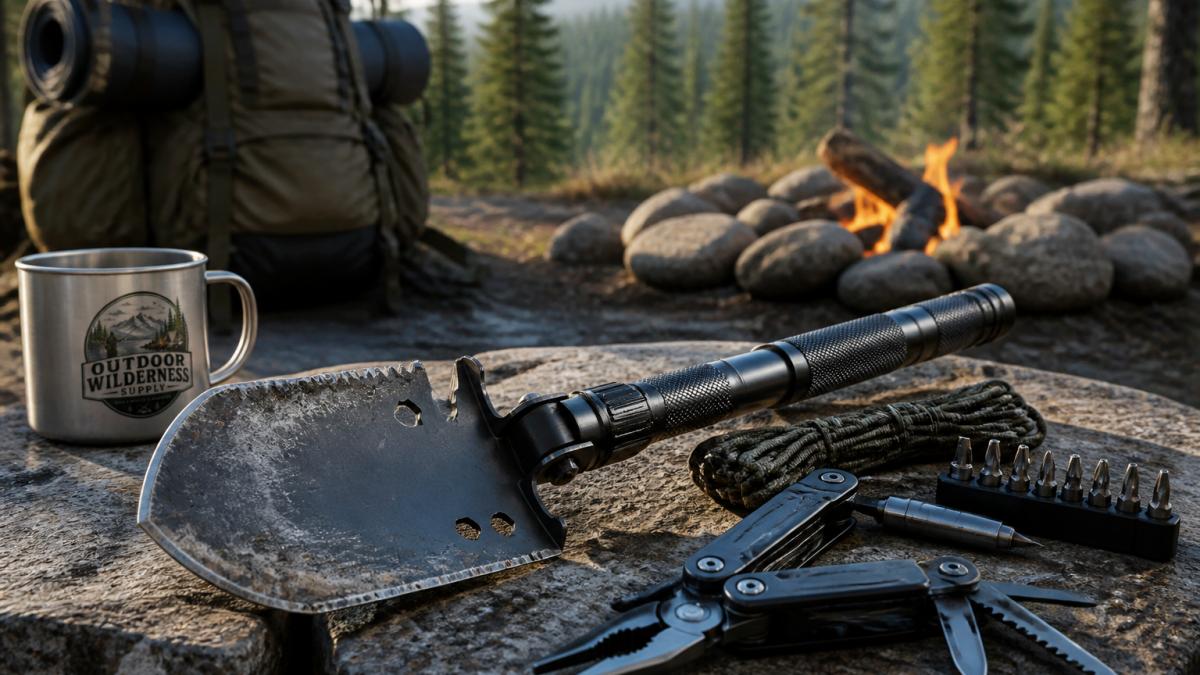
Stealth Tact Shovel: 12 Tools, One Shaft
Our top pick for most wilderness trips.
The modular shaft extends to 32.5 inches for digging and collapses to 12 inches for storage, with a lock-in-place thread system keeping every section solid.
The 440C steel and aircraft aluminum build keeps it light for its size, though at 32.5 inches extended it lives in your pack rather than on your belt.
Folding Shovel Multi-tool: The Budget 7-in-1
For $25, this 7-in-1 covers shovel, hoe, saw, knife, harpoon, awl, and whistle. The aluminum alloy body handles camp chores and light digging.
At 2 lbs and 5" x 10" x 2" folded, it fits a vehicle kit or base camp box better than an ultralight backpack, and the harpoon function doubles for fishing.
Where it falls short: 2 lbs is heavy for long-distance backpacking. Treat it as a camp and vehicle tool, not a thru-hike companion.
Multifunctional Folding Shovel: 6 Tools Under a Pound
At roughly 0.45 kg, this 6-in-1 is the lightest shovel in the lineup, running shovel, pick, saw, hex wrench, nail puller, and ruler, with a pickaxe on one side and a shovel on the other.
The alloy steel head carries a 40-45° quenching hardness, so it's heat-treated for real work. It folds to 16 cm and unfolds to 41.5 cm, and the non-slip handle includes an auxiliary rope.
The tradeoff is scale: it's a compact tool for light digging, gardening, and emergency kits, and won't move serious soil like the Stealth Tact Shovel.
Flex Titan: The Modular Plier-Based Option
The Flex Titan is the repair specialist: 6 interchangeable FLEX implements and a pre-installed D2 steel blade, with 2 additional implements separately in the pack, and a pen tucked into the frame.
The plier head covers needle-nose pliers, regular pliers, a wire-cutter, and a built-in fixed tool.
At $109.99 and 311.2 g, it costs more than the shovels and weighs more than a pocket tool. If you're fixing gear rather than digging holes, this is the one.
MBT3: The Camp Kitchen Multi-Tool
The MBT3 handles the other half of camp life: eating well. It combines a grill fork, spatula, BBQ tong, knife, bottle opener, and corkscrew in one folding frame.
At $35.99, it's the tool you reach for after the fire is lit. It won't dig, cut firewood, or signal for help, so pair it with a shovel or plier-based tool rather than treating it as a standalone survival pick.
Choosing a Backpacking Multi-Tool by Weight and Task
Weight is the easy filter. The harder question is which jobs you actually need the tool to do, because a multi-tool only earns its ounces when it replaces gear you'd otherwise carry separately. Rank tools by task, then check weight.
Rank the tool by the job, not the tool count
Walk through the jobs below and note which apply to your trips. A tool that covers three is worth more than a 12-in-1 that covers none well.
- Shelter and camp repair: Pliers, wire cutter, and a Phillips or flat driver matter. Tarp grommets, tent pole splints, and stove fittings fail in ways that need gripping or turning, not cutting.
- Fire preparation: A saw that bites dry wood, plus a scraper or ferro-rod striker, does more than a dozen small implements. Test the saw on a thumb-thick branch first.
- Food prep and water access: A clean, locking blade and a can or bottle opener cover most camp kitchen needs. A flat rock keeps the blade out of the dirt.
Match the tool to the trip profile
- Ultralight backpacking, 1-3 nights: Multifunctional Folding Shovel (0.45 kg) for light digging and emergency prep, or a compact plier-based tool if repair is the priority. Leave the shovel home if you won't dig.
- Standard backpacking, 3-7 nights: Stealth Tact Shovel for all-around camp and survival duty, or the Flex Titan at 311.2 g if you expect to fix gear rather than move soil.
- Base camp or vehicle kit: Folding Shovel Multi-tool at 2 lbs, where weight matters less and the extra digging leverage helps.
When a dedicated tool beats the multi-tool
A multi-tool is a compromise by design. For shelter repair, food prep, and equipment maintenance, that's usually fine. For three jobs, a dedicated tool is safer:

- Cutting and batoning firewood: A fixed-blade knife or folding saw outperforms any multi-tool blade. Multi-tool blades are shorter and thinner, and the hinge is a weak point under impact.
- Heavy digging: A full-size shovel moves more soil with less effort than a folding shaft, and won't wobble at the joint.
- Chopping: A hatchet or small axe beats a multi-tool hatchet function every time. If you plan to process wood, carry the axe and let the multi-tool handle everything else.
Think of durable multi tools as your repair and camp kit, and dedicated tools as your cutting and digging kit. Carrying both is not redundancy; it is matching the tool to the job.
Survival Knife vs Multi-Tool: What Each One Does Better
A survival knife wins on cutting, carving, and batoning. A multi-tool wins on repair, digging, and versatility. Neither replaces the other.
A fixed-blade knife gives you a longer, stronger edge and better control for carving and food prep. A multi-tool gives you pliers, screwdrivers, wire cutters, and a saw in a package that folds flat.
The Stealth Tact Shovel blurs the line with its knife, hatchet, and saw functions, but a dedicated knife still cuts cleaner.
Multi-Tool Maintenance and Field Care That Prevents Failures
Most multi-tool failures trace back to neglect, not bad steel. Tools that quit mid-trip usually fail at one of four points: a hinge packed with grit, a lock that no longer seats, a loosened thread joint, or a rolled edge.
The four failure modes to watch
- Hinge wear and stiffness: Grit and dried sap turn a smooth action sticky, and the hinge wears unevenly into side-to-side play. Clean and oil the pivot after every trip involving dirt, sand, or ash.
- Lock reliability: A liner lock or lock-back that doesn't fully seat is a safety issue. Test it by opening the blade and pressing the spine against a firm surface with light pressure. If it folds, stop using that blade for hard tasks until you clean and reseat the lock.
- Thread and joint loosening on modular shafts: Grit in the thread lock system is the most common cause of a wobbly shaft. Brush the threads, reseat the sections, and check each joint seats fully before you strike or dig.
Field care routine
- Dry it after water exposure. Wipe hinges, threads, and blades, then air dry before folding. Folding a wet tool traps moisture against the steel.
- Oil the pivot points. A drop of light oil on hinges and locking mechanisms keeps action smooth. In cold weather, use a light oil that won't stiffen.
- Clean threads on modular shafts. A small brush or rag twisted into the threads clears grit. Reseat the sections and confirm the lock engages.
Repairability and warranty limits
Multi-tools aren't designed to be fully field-serviceable. A few realistic expectations:
- What you can fix in the field: Loose screws (if the tool uses standard fasteners), a rolled edge, a gritty pivot, and a thread joint that needs cleaning. A small driver and sharpener cover most of it.
- What you cannot fix in the field: A snapped blade, a cracked plier jaw, a stripped thread, or a broken lock spring. These end the tool's trip.
- Warranty reality: Warranties vary widely. Some cover defects in materials and workmanship but exclude rust, normal wear, and misuse damage. Before you rely on a tool, read what the warranty covers and keep your receipt. A long warranty is only useful if the failure it covers is the failure you experience.
Conclusion: Match the Tool to the Trip
The right multi-tool matches your terrain, pack weight, and the tasks you'll actually face. A day by the water calls for different gear than a week in the backcountry.
Outdoor Wilderness Supply stocks a curated selection of multi-functional survival tools built for real field use, from the 12-in-1 Stealth Tact Shovel to the modular Flex Titan and the camp-ready MBT3.

Browse our survival tools collection and choose the option that fits your next trip.
Frequently Asked Questions
What makes a multi-tool suitable for wilderness survival?
Look for locking tools that stay open under load, a blade that holds an edge, and a construction that survives twisting force. The Stealth Tact Shovel uses 440C steel and aircraft aluminum with a lock-in-place thread system, while the Flex Titan locks every implement and carries a 25-year warranty. Tool count matters less than whether the pliers, blade, and saw actually work when your hands are cold and wet.
Are full-size or compact multi-tools better for survival kits?
It depends on your carry method. A compact option like the Multifunctional Folding Shovel folds to 16 cm and weighs about 0.45 kg, so it disappears into a pack pocket. The Stealth Tact Shovel runs 32.5 inches extended but collapses to 12 inches, giving you leverage for digging without permanent bulk. Pack the compact tool for hiking and the full-size one for basecamp or vehicle kits.
How do you maintain a multi-tool in wet or muddy conditions?
Rinse grit out of the pivot points with clean water, dry every surface, then apply a thin coat of oil to the joints and blade. Mud left in a folding mechanism grinds the washers and speeds up play in the hinges. After any trip where a durable multi tool gets submerged, work each implement open and closed a few times to spread the oil before storing it.
Can a multi-tool replace a fixed-blade knife for wilderness use?
For most camp tasks, yes. A multi-tool handles cutting cord, opening packaging, and food prep, and models like the Flex Titan add pliers, scissors, and a wire cutter that a knife cannot match. For batoning firewood or heavy carving, a fixed-blade knife is still the safer choice because folding blades put stress on the hinge rather than a solid tang.
How should you test a multi-tool before taking it into the wilderness?
Open and lock every implement at home, then put each one under real load: cut rope with the blade, twist wire with the pliers, saw through a dry branch. Check the locking mechanism for wobble and confirm the handle stays comfortable during hard gripping. Do this before your trip so a loose hinge or dull saw shows up in your garage instead of on the trail.