

Decathlon Alternatives: Specialized Camping Gear Guide
Table of Contents
- Why Serious Campers Look Beyond Big-Box Outdoor Retailers
- Quick Comparison: Specialized Camping Gear Options
- How to Choose Specialized Camping Gear That Lasts
- Durable Camping Gear for Extreme Conditions
- Best Outdoor Gear Stores for Serious Campers
- Repairability, Sustainability, and the Used Gear Market
- Conclusion
- Frequently Asked Questions
Last Updated: September 28, 2026
Why Serious Campers Look Beyond Big-Box Outdoor Retailers
The camping gear aisle at a big-box store looks impressive until you read the spec sheet. Most of what fills those shelves is built for occasional weekend use, not for the conditions serious campers actually face. That gap is exactly why so many backpackers and trekkers start hunting for decathlon alternatives for specialized camping gear once they've had a pole snap or a floor soak through on a three-day trip.
This guide from Outdoor Wilderness Supply breaks down what separates entry-level gear from trail-ready equipment, and where to find the specialized camping gear that holds up.
The core issue isn't price. It's design intent. Big-box retailers stock high-volume items that work fine for a car campground and fall apart under real load. A tent rated for fair weather isn't a mountaineering shelter, no matter how similar the two look on a shelf.
Below, we'll walk through how to read the specs that matter, which gear categories deserve your budget, and how to avoid paying premium prices for gear that isn't actually built better.
Quick Comparison: Specialized Camping Gear Options
Four categories cover most of what serious campers upgrade first: shelter, sleep system, cooking, and pack weight. Getting these right matters more than any accessory, because they are the systems that fail first when weather turns and the ones that carry the most weight on your back.
The table below frames each category by the spec that actually predicts field performance, not by marketing tier. Use the "Spec That Matters" column as your filter before you look at any label.
| Category | Spec That Matters | What to Look For | Priority |
|---|---|---|---|
| Shelter | Hydrostatic head + denier | Trekking-pole design, low packed weight, puncture-resistant floor | Highest |
| Sleep system | Temperature rating | Comfort rating vs. limit rating, packability, R-value of pad | High |
| Cooking | Heat-exchanger efficiency | Nested design, piezo ignition, isobutane compatibility | High |
| Camp kitchen | Weatherproof case + setup time | All-in-one system, rechargeable components, transport weight | Situational |
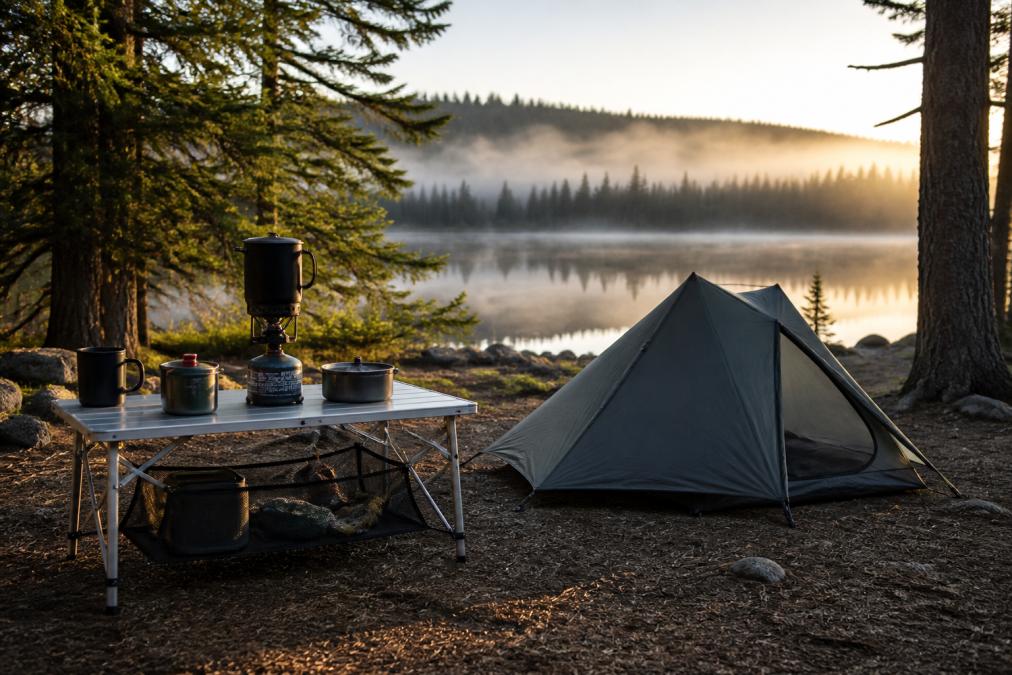
Shelter usually delivers the biggest weight savings for the money. The Trekker Tent 2 weighs 2 lb 12 oz and pitches with trekking poles, sticks, or a ridge line between two trees. Setup takes about a minute. The Trekker Tent 1A is the solo minimalist pick, while the Trekker Tent 2.2 adds mesh sidewalls for humid or high-altitude trips where condensation becomes the real enemy.

House Brands vs. Premium Labels: What the Spec Sheet Actually Shows
Most big-box house brands and premium labels use the same fabric mills and the same coatings. The difference usually shows up in three places: seam sealing, pole or support design, and quality control on the floor material. A house-brand tent with a taped, seam-sealed fly and a 3,000 mm hydrostatic head will outperform a premium tent with a 1,500 mm fly and glued seams in sustained rain, regardless of what the logo says.
A common pattern serious campers notice: house brands win on price-per-spec at the entry level, premium labels win on warranty and replacement-part availability at the top end, and the sweet spot for value sits with small specialty makers who publish full spec sheets. That is the tier most "budget vs. premium" articles skip entirely.
Repairability as a Buying Filter
Before price, ask one question: can this item be repaired in the field? A trekking-pole shelter has no proprietary shock-cord pole to snap and no factory-only replacement part, you swap in a stick or a spare pole section and keep hiking. A nested stove with a standard isobutane thread accepts canisters from multiple makers. A tent with a sewn-in bathtub floor and no replaceable groundsheet is a one-failure item.
That filter changes the comparison table above. The categories with the highest repairability, trekking-pole shelter, nested cooking systems, pad-and-quilt sleep systems, are also the ones where a mid-priced option often beats both the cheapest house brand and the most expensive premium label over a five-year ownership window.
How to Choose Specialized Camping Gear That Lasts
Choosing specialized camping gear comes down to three specs: weight-to-performance ratio, material durability, and how the item handles weather you'll actually encounter.
Start with weight. A tent that saves two pounds matters more on mile eight than any feature list suggests. Then check construction. Trekking pole tents eliminate the fragile fiberglass poles that break first on budget shelters. Finally, match the gear to your conditions.
Durable Camping Gear for Extreme Conditions
Durable camping gear for extreme conditions starts with shelter and cooking, because those are the two systems that fail first when weather turns.
Best Outdoor Gear Stores for Serious Campers
The best outdoor gear stores for serious campers are the ones that publish real specs, not just lifestyle photos. If a retailer won't tell you the packed weight, the fabric denier, or the hydrostatic head rating, they're selling you a feeling, not a piece of equipment.
A Four-Point Test for Any Retailer
Run every store, big-box, specialty, or direct-to-consumer, through the same four checks:
- Full spec sheets on every product page. Packed weight, floor denier, fly hydrostatic head, temperature rating, and material composition should be listed, not buried in a Q&A.
- Replacement parts and repair support. Can you buy a new pole section, a footprint, a valve, or a gasket? A store that only sells complete units is a store that expects you to replace, not repair.
- Category specialization. A retailer that carries one good shelter and fifty mediocre ones isn't curating, it's stocking. Depth in shelter, sleep, and cooking tells you where their buying team actually knows the category.
- Consistent quality standards across the catalog. If the same store sells a 3,000 mm fly next to a 1,200 mm fly with no distinction in how they're presented, the spec sheet isn't doing its job.
The Used and Secondary Gear Market
Most gear guides skip the secondary market entirely, and that is a mistake for anyone shopping on a budget. Shelters, pads, and cookware hold value well because the underlying specs, denier, hydrostatic head, R-value, burner output, don't change much year to year. A used trekking-pole tent with intact fabric and sealed seams often performs identically to a new one at a fraction of the cost.
Before buying used, inspect four things:
- Floor material for pinholes, delamination, or previous patch jobs
- Guy-line attachment points for fraying or pulled stitching
- Venting and mesh for tears that will let condensation or bugs through
- Seam tape for lifting, which is the first sign the fly is near end of life
Where Specialty Retail Fits
For campers who want a full basecamp setup, the VOZ Camp Kitchen is the outlier pick. It packs a butane stove, a built-in sink with a rechargeable faucet, a 2-gallon water tank, a cutting board, an LED light, and a full utensil set into a weatherproof case. Setup takes under 30 seconds. It weighs about 57 lbs, so it's built for truck camping and overlanding, not backpacking.

Repairability, Sustainability, and the Used Gear Market
Repairability is the sustainability angle most gear guides skip. A tent that uses your own trekking poles for support has fewer proprietary parts to break and replace. That's a design choice with real longevity behind it.
Conclusion
Finding decathlon alternatives for specialized camping gear isn't about chasing a brand. It's about reading specs, matching gear to your actual conditions, and buying equipment built to last more than one season.
Frequently Asked Questions
What should I look for when choosing specialized camping gear?
Focus on weight, packed size, and weather resistance. For tents, check the denier of the fabric and the hydrostatic head rating. For cooking systems, look at fuel efficiency and whether the stove works at high altitude. Durable camping gear for extreme conditions should also have reinforced stress points, like guy-line anchors and puncture-resistant floors. Repairability matters too; gear you can fix in the field lasts longer than gear you have to replace.
How do premium outdoor brands compare to budget-friendly options?
Budget gear often uses heavier materials and simpler construction, which can mean more weight and less durability over time. Premium options typically use lighter fabrics, better waterproof coatings, and more refined designs like trekking pole tents that save weight without sacrificing space. The trade-off is cost. For occasional car camping, budget gear works. For backpacking or extreme conditions, the weight savings and longevity of better gear usually justify the higher price.
Are there US-based alternatives to international outdoor retailers?
Yes. Several US-based shops focus on specialized camping gear rather than mass-market general equipment. These stores often carry niche brands and provide more detailed product guidance. When evaluating any retailer, look for transparent specifications, real customer reviews, and a clear return policy. A store that specializes in camping, fishing, and survival gear will typically offer more knowledgeable support than a general big-box retailer.
Which outdoor brands offer the best warranty and repair services?
Warranty coverage varies widely. Some brands offer lifetime warranties on hard goods like stoves and trekking poles, while others limit coverage to one or two years. Repair services are less common but growing, especially for tents and packs. Before buying, check whether the brand sells replacement parts like poles, stakes, or fabric patches. Gear that can be repaired locally or with manufacturer-supplied parts reduces long-term waste and cost.