

How to Verify Outdoor Gear Quality Before You Buy
Last Updated: November 8, 2026
Quick Summary
Verify outdoor gear quality by inspecting materials, seams, taping, and hardware before trusting the label. Run simple at-home tests like the flex, zip, water bead, load, and twist tests, then apply category-specific pass/fail checks. Read warranty terms and review methodology before you pay.
- Run zippers the full length ten times; they should glide without catching.
- Load a pack with about 20 pounds and walk five minutes to test hip belt transfer.
- Retire hard goods like carabiners after a significant fall or drop onto a hard surface.
- Ask how used gear was stored and how often it was used before buying.
- Trustworthy reviews state a methodology and name real-world test conditions.
Table of Contents
- Start With the Outdoor Gear Quality Checklist
- Run an Outdoor Gear Durability Test at Home
- How to Inspect Used Outdoor Gear Before You Pay
- How to Find Trustworthy Outdoor Gear Reviews
- Check Waterproofing, Coatings, and Weather Resistance
- Verify Safety-Critical Gear and Warranty Coverage
- Put Your Shortlist to the Test With Outdoor Wilderness Supply
- Frequently Asked Questions
Start With the Outdoor Gear Quality Checklist
Learning how to verify outdoor gear quality comes down to one habit: inspect the details before you trust the label. A jacket, pack, or boot earns its place on the trail through materials, seams, and hardware, not through a slogan on the hangtag.
Here is a practical outdoor gear quality checklist:
- Materials: Feel the face fabric. Thin and slick usually means light duty.
- Seams: Look for tight, even stitching with no loose threads.
- Taping: Check that seam tape sits flat and fully covers the stitch line.
- Hardware: Test every zipper, buckle, and strap end.
- Weight: Compare claimed weight against how the item actually feels.
- Fit: Move in it. Bend, reach, and squat.
- Warranty: Read the terms before you pay, not after.
Most buyers skip straight to price. That is a mistake. A cheap item that fails in the rain costs more than a solid one that lasts.
Materials and Face Fabric
Face fabric is the outer material of a jacket, pack, or tent. It takes the abuse, so it tells you a lot about construction quality. Run your thumb across it.
Nylon and polyester dominate outdoor equipment for good reason: both handle wear and tear well. To see what quality leather looks like in practice, browse our breathable leather hiking boots and study the grain and stitching up close.

Watch the laminate layers too. A laminated fabric bonds a membrane to the face fabric. If the bond looks bubbly or uneven, water resistance will suffer over time.
Seams, Stitching, and Seam Taping
Seams are where most gear leaks and most gear fails. A waterproof jacket is only as waterproof as its weakest stitch line.
Check three things:
- Stitch density. Even, tight stitches beat long, loose ones.
- Seam tape. It should cover the stitch holes completely, with no lifting edges.
- Stress points. Look at shoulder straps, pocket corners, and pull tabs.
A common mistake is trusting a waterproof rating without looking at the seams. That rating assumes sealed seams. If the taping is peeling, the number means nothing.
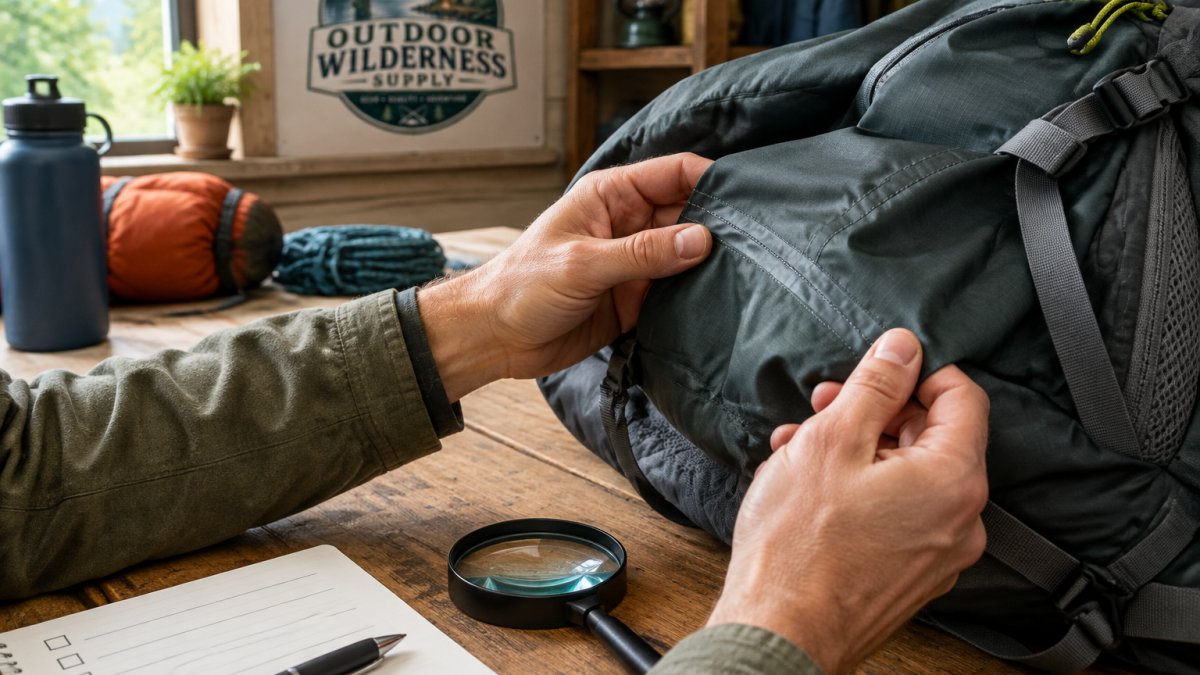
Run an Outdoor Gear Durability Test at Home
You can run a simple outdoor gear durability test before your first trip.
Start with the flex test. Bend the fabric at a seam and hold it for a few seconds, then check for cracking, whitening, or separation.
Then try these:
- Zip test: Run zippers the full length ten times. They should glide without catching.
- Water bead test: Drip water on the surface. It should bead up if a DWR coating is present.
- Load test: Fill a pack with weight and carry it around the room. Watch the seams.
- Twist test: Twist the empty pack. A good frame springs back into shape.
If you want a pack to practice on, our water-resistant 40L rucksack gives you a real example to inspect using these exact methods.

Category-Specific Pass/Fail Checks
Generic tests only get you so far.
Backpacks. Load the pack with about 20 pounds and walk for five minutes. Pass if the hip belt transfers weight to your hips and the shoulder straps stay flat. Fail if the frame sheet folds, the load lifter straps bottom out, or stitching at the shoulder-strap anchor starts to pull. Check the bottom panel for abrasion, a pack that scuffs through in one season is not built for rough use.
Footwear. Flex the boot or shoe at the ball of the foot and watch the midsole.
Tents. Set the tent up and check the pole joints and stake-out points. Pass if poles seat fully and the fly tension is even.
Sleeping bags. Loft the bag and let it sit for ten minutes. Pass if it recovers most of its thickness. Fail if baffles collapse or down leaks through the shell fabric. Check the zipper garage and draft tube, a bag that loses heat at the zipper is a three-season bag at best.
Clothing. Stretch the fabric at the underarm and crotch seams. Pass if the seam holds without grinning.
What Home Tests Can and Cannot Tell You
Home tests spot obvious defects and let you compare items side by side, but they are not lab certification. They cannot measure hydrostatic head, abrasion resistance in cycles, or seam strength in pounds per inch.
Watch out: a fabric that passes the water bead test on day one can still wet out after a few hours of steady rain, so repeat the test after the item has been used and washed.
Each gear category has its own failure points, and these checks give you a clear pass or fail for each one.
| Gear category | Pass if | Fail if |
|---|---|---|
| Backpacks | Hip belt transfers weight; shoulder straps stay flat | Frame sheet folds; stitching at shoulder-strap anchor pulls |
| Footwear | Midsole returns to shape without sharp creasing | Visible crack line; outsole separates from upper at toe |
| Tents | Poles seat fully; fly tension is even | Pole section splinters at ferrule; floor shows pinholes |
| Sleeping bags | Bag recovers most of its thickness | Baffles collapse; down leaks through shell fabric |
| Clothing | Seam holds without grinning | Stitch elongation; fabric pulls away from seam tape |
How to Inspect Used Outdoor Gear Before You Pay
Used gear can be a smart buy, but only if you know how to inspect used outdoor gear properly. The savings are real. The risk is buying someone else's worn-out problem.
Work through the item in this order:
- Fabric: Look for thin spots, pilling, and abrasion at the shoulders and hips.
- Coating: Check for flaking or a chalky white residue, which signals a failing DWR coating.
- Seams: Run a finger along every taped seam. Lift the edges.
- Zippers: Test each one. Replacement is possible but annoying.
- Foam and padding: Press it. Foam that stays compressed is dead.
- Smells: Mildew is hard to remove and often means stored damp.
- Repairability: Ask whether parts are replaceable.
What most guides miss is provenance. Ask how the item was stored and how often it was used. A well-kept ten-year-old jacket can beat a neglected two-year-old one.
How to Find Trustworthy Outdoor Gear Reviews
Trustworthy outdoor gear reviews show you the test, not just the verdict. That single rule filters out most marketing hype.
When you read a product review, ask four questions:
- Did the reviewer state a methodology? Independent testing means controlled conditions and repeatable steps.
- Did they name real-world conditions? Altitude, weather, and terrain matter.
- Is there user feedback beyond the brand? Look for long-term owner reports.
- Does the reviewer admit limits? An expert reviewer names what failed.
Be careful with reviews that only repeat manufacturer claims. A product tester who never mentions a downside is not testing. They are advertising.
If you want a deeper look at how to read marketing claims critically, our guide on how to spot greenwashing in outdoor gear walks through the language to watch for.
Check Waterproofing, Coatings, and Weather Resistance
Waterproofing is the most oversold spec in outdoor equipment. Learn to read it properly and you will avoid a lot of wet, cold disappointment.
Two terms matter. Water resistance means the fabric slows water but will eventually soak through. Waterproofing means a membrane plus sealed seams keeps water out under pressure. A DWR coating is the finish that makes water bead on the surface. It wears off with use and needs refreshing.
Test weather resistance yourself:
- Pour a small amount of water on the fabric and watch how it behaves.
- Check that zippers have storm flaps or water-resistant closures.
- Confirm seam taping covers every exposed stitch line.
- Look at the hood and cuffs, where rain gets in first.
For a concrete example to evaluate, our waterproof hooded shell jacket shows how a proper weather-resistant shell is put together. Compare its closures and seams against the checklist above.
Verify Safety-Critical Gear and Warranty Coverage
Some gear carries real consequences if it fails. Climbing hardware, helmets, and flotation gear belong in that group. For these items, marketing claims are not enough, and a visual check is not the same as a qualified inspection.
Verify safety-critical equipment by checking:
- Certification marks printed on the product itself, not just the box.
- Manufacturer documentation that names the standard met.
- Serial or batch numbers that let you confirm authenticity.
- Recall notices from the manufacturer before you buy used.
Counterfeit detection matters here. Buy safety gear from sellers who can show provenance, and avoid deeply discounted items with no paperwork.
Inspection Limits and Retirement Criteria
Every piece of life-safety gear has a service life, and most of it is shorter than owners assume.
Climbing hardware. Soft goods such as slings, harnesses, and ropes degrade from UV exposure, abrasion, and chemical contact.
Flotation gear. Life jackets lose buoyancy when foam degrades or the shell tears.
Paddling gear. Paddles and kayaks fail at joints and stress points.
When in doubt, seek a qualified inspection.
Warranty, Recalls, and Documentation
Warranty coverage is the other half of the equation. Read the terms before you pay. Check what is covered, how long it lasts, and whether it transfers to a second owner.
Register the product with the manufacturer when you buy it, and keep the receipt and any batch or serial number, that paperwork makes a recall or warranty claim possible years later.
Put Your Shortlist to the Test With Outdoor Wilderness Supply
The final step is simple. Take your shortlist and apply every check in this guide to the actual item in front of you.
At Outdoor Wilderness Supply, we stock gear built for practical performance, from camping and fishing equipment to multi-functional survival tools. Start with the multifunctional outdoor survival kit and run it through the checklist.

Quality is not a claim you read. It is something you check.
Frequently Asked Questions
How can you tell if outdoor gear is good quality?
Look at the construction details before anything else. Check that seams are tight and evenly stitched, that high-wear areas have bartacks or double stitching, and that zippers are smooth metal or quality coil rather than flimsy plastic. Feel the face fabric: it should have some body without feeling stiff or papery. On waterproof items, confirm seam taping covers every seam.
What should you check before buying outdoor gear online?
Start with the outdoor gear quality checklist: fabric and laminate, seam construction, hardware, fit and adjustability, and warranty terms. Read the product listing for specific materials rather than vague words like premium. Then look for reviews that describe how the gear performed over months, not just unboxing impressions. Ask the seller directly about return policy and whether the item is covered against defects. If a listing shows only studio photos and no construction close-ups, request more detail before you commit.
How do you inspect used outdoor gear for damage?
Inspect used outdoor gear in daylight and go seam by seam. Run your fingers along every seam looking for pulled threads, loose tape, or gaps. Check zippers by running them fully open and closed several times. Flex the fabric at stress points like shoulder straps and hipbelt anchors to reveal cracking or delamination. Smell the item for mildew, and look inside stuff sacks and pockets for sand or moisture damage. On tents, pitch it before buying if you can, and check the floor and rainfly for pinholes held up to light.
How do you evaluate the durability of camping gear?
An outdoor gear durability test does not need a lab. Load the pack or pitch the tent and use it as intended for a short trip, then inspect the wear points afterward. Look for fraying at strap junctions, abrasion on the base of packs and tent floors, and any change in how zippers run. Repeat the same load and check for stretching or seam creep. Gear that shows no wear after a few honest outings usually holds up. Also confirm the warranty covers defects, since that is your backstop if a seam or coating fails early.
